
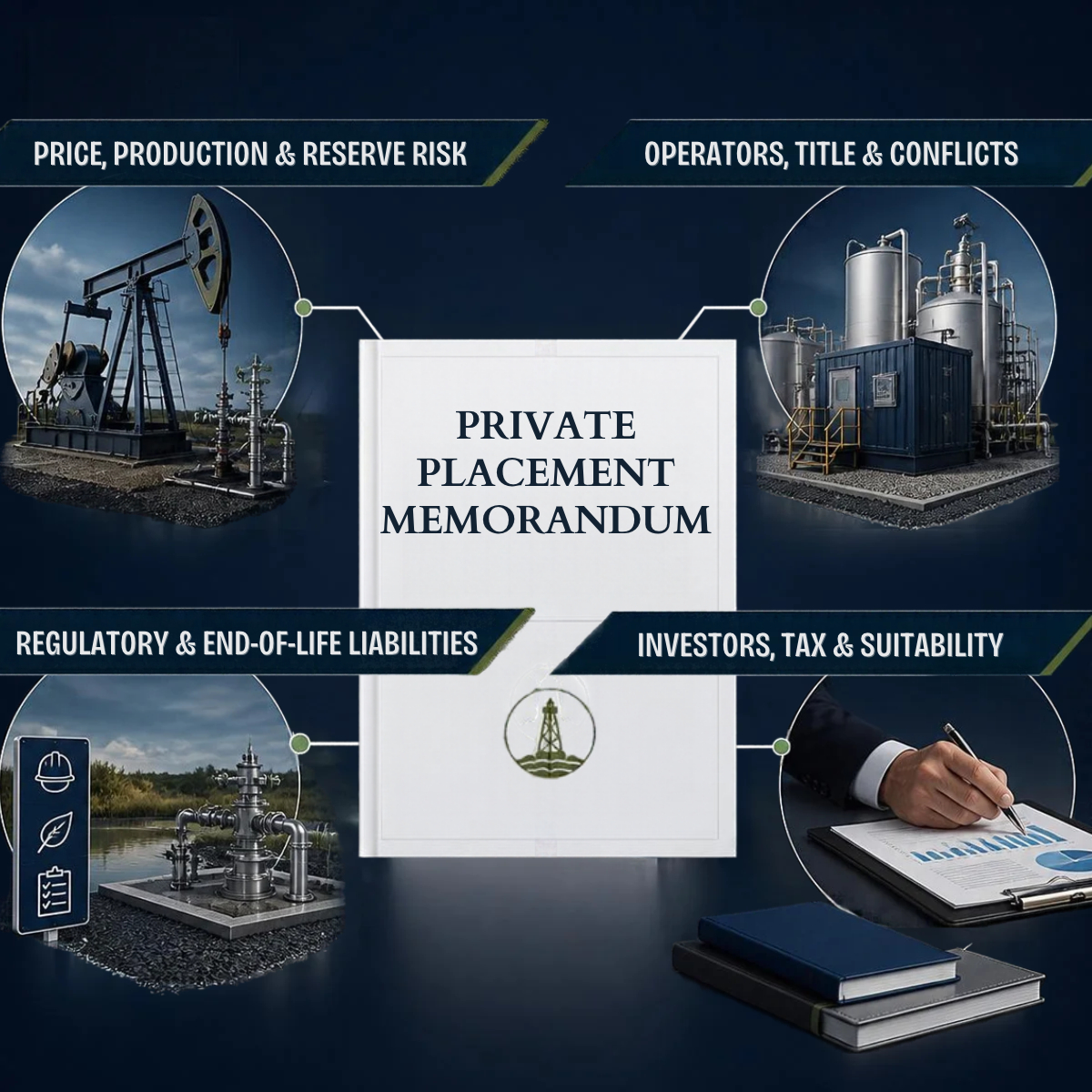
When an energy investment falls short of expectations, investors go back to the PPM to see exactly what they were told. If it says nothing about the specific problem behind the shortfall, some will allege they were misled, or worse, defrauded. Picture a sponsor reusing the PPM from its last deal, a drilling program it operated itself and sold to individuals. The new plan buys producing wells run by someone else. The old document warns about dry holes and cost overruns but says almost nothing about production declines or an outside operator. Every warning in it is still true. None of them is the risk this investor actually faces. Risk disclosure in an energy offering comes down to four related areas: price, production, and reserve risk; operators, title, and conflicts; regulatory and end-of-life liabilities; and the investors themselves. Not a checklist. A framework for making sure the disclosures match the deal.
Price, Production & Reserve Risk
Commodity price risk should appear in every energy PPM. A tailored disclosure ties it to the specific program. Oil and gas prices are set by markets that no sponsor can control, and distributions move with them, so the PPM should explain how sensitive the plan’s results are to a decline and whether the sponsor intends to hedge. If it does, the document should describe what the hedges cover and what they cost or give up.
Drilling and completion risk should be disclosed at the level the program actually carries it. A plan that drills new wells faces wells that come in dry, cost more than budgeted, take longer than planned, or produce less than expected. A plan that acquires producing properties faces different risks altogether, such as maintenance costs or unknown ecological hazards. That is the deficiency in the example above: pages on drilling risk with little mention of production declines fail to adequately disclose investor risk.
Reserve estimates are engineering judgments built on assumptions about prices, costs, and how quickly production will decline, and they are revised as wells perform. The disclosures should identify who prepared the estimates, state the assumptions behind them in terms an investor can follow, and distinguish producing reserves from nonproducing reserves. It should also make clear that actual results may differ, sometimes materially, from the estimate.
Operator, Title & Conflicts
Where an investor’s returns depend on an operator, the disclosures should say so specifically. The operator decides when to drill, which contractors to use, how to manage costs and safety, and how to report results, and the investor typically has little ability to direct or replace it. The disclosures should name the operator, describe its experience and financial condition, and explain what the investor and the sponsor can and cannot control. A sponsor that used to operate its own wells and now relies on another company, as in the example above, cannot carry forward the old disclosure. If the sponsor is the operator, the disclosure shifts to the sponsor’s own ability to perform.
An interest is only worth what the sponsor can prove it owns. Defects in the chain of title to leases or mineral rights can reduce or eliminate an interest, and curing them can be costly or impossible. Disclosures should describe what title work has been completed, what remains, and what happens to the program if a defect appears.
Energy sponsors frequently have affiliates that operate wells, provide services, or sponsor competing programs. Each relationship creates a point where the sponsor’s interests and the investor’s may diverge. A conflict that is disclosed in plain terms becomes a risk the investor has knowingly accepted. A conflict that is discovered later becomes a dispute.
Regulatory & End-of-Life Liabilities
Energy assets carry obligations that outlast the revenue they generate. Drilling, production, and disposal are regulated at the federal and state levels, and the rules on emissions, water, spills, and site conditions change over time. Owners of working interests can share in liabilities that arise from operations, even when they did not run the wells. The PPM should describe the regulatory environment applicable to the plan’s operations and should not settle for a general statement that the industry is regulated.
Plugging and abandonment is the clearest example. When a well stops producing, someone must plug it and restore the site, often years after the last meaningful distribution. Regulators may require bonds or other financial assurance, and the eventual cost is difficult to estimate. Disclosures should make clear who bears that cost, whether any reserve exists for it, and whether the investor’s type of interest carries a share of it. Investors should not have to infer the answer.
Investors, Tax & Suitability
The investors are the last consideration and, in some ways, the one that ties the others together. Investors do not change the risks of the wells. They change which risks matter and how much a sponsor must say about them.
Tax treatment is the clearest example. Tax law can change, and its effect varies by investor. Income from an operating working interest held through a partnership can be unrelated business taxable income, which means an entity may owe tax it did not expect. A sponsor who markets to retirement accounts but writes its tax disclosure for taxable individuals has failed the purpose of the disclosure. The PPM should also avoid promising any tax result and should direct investors to their own advisers.
Concentration and liquidity work the same way. Interests in a private energy program generally cannot be freely resold. Concentration takes two forms. For example, a plan built only on a few wells in one basin heightens risk inside the investment, while a proportionally large commitment concentrates risk in the investor’s own finances. The first belongs in the risk section. The second belongs in the suitability standards.
Suitability ties these points together. The standards a sponsor sets, and the representations investors make when they subscribe, should reflect the people actually being solicited. A PPM that fits the offering and its investors is easier for everyone involved in the offering to stand behind.
Strategy and disclosure are not separate exercises. A sponsor’s choices about what to drill, who will operate, and whom to solicit determine what the PPM must disclose. That is also why disclosures cannot simply be carried over from the last deal. New projects bring new risks which require new disclosures. The four areas overlap, so a change in one changes what the PPM must say in the others.
Conclusion
When something falls short, investors look back at what they were told, and the disclosures should describe the deal they actually bought, not the one that used to be on file. Writing PPM disclosures that fit a specific energy offering is entirely doable, with the right help. At RR&A, we help clients turn their actual strategy into disclosure that holds up. Before your next offering goes out, send us your PPM and your deal terms side by side, we will tell you where they do not match.
Disclaimer: The information and material on this website is general information about our practice and firm. This information does not offer specific legal advice and the use of this information does not create an attorney-client relationship with RR&A or any of its attorneys. The information on this website should not be used for legal advice, and persons should not act upon the information on this website without engaging professional legal counsel.

Hunter is a Law Clerk at R. Reese & Associates in the Houston office. To learn more about Hunter, visit his attorney page.